MusicThe Work Before the Wonder: Inside Trinidad's Panyards
A hundred players, eight minutes of memorized arrangement, zero sheet music — inside the panyards where Panorama is actually won.
LuxTuris Editorial Desk · May 20, 2026
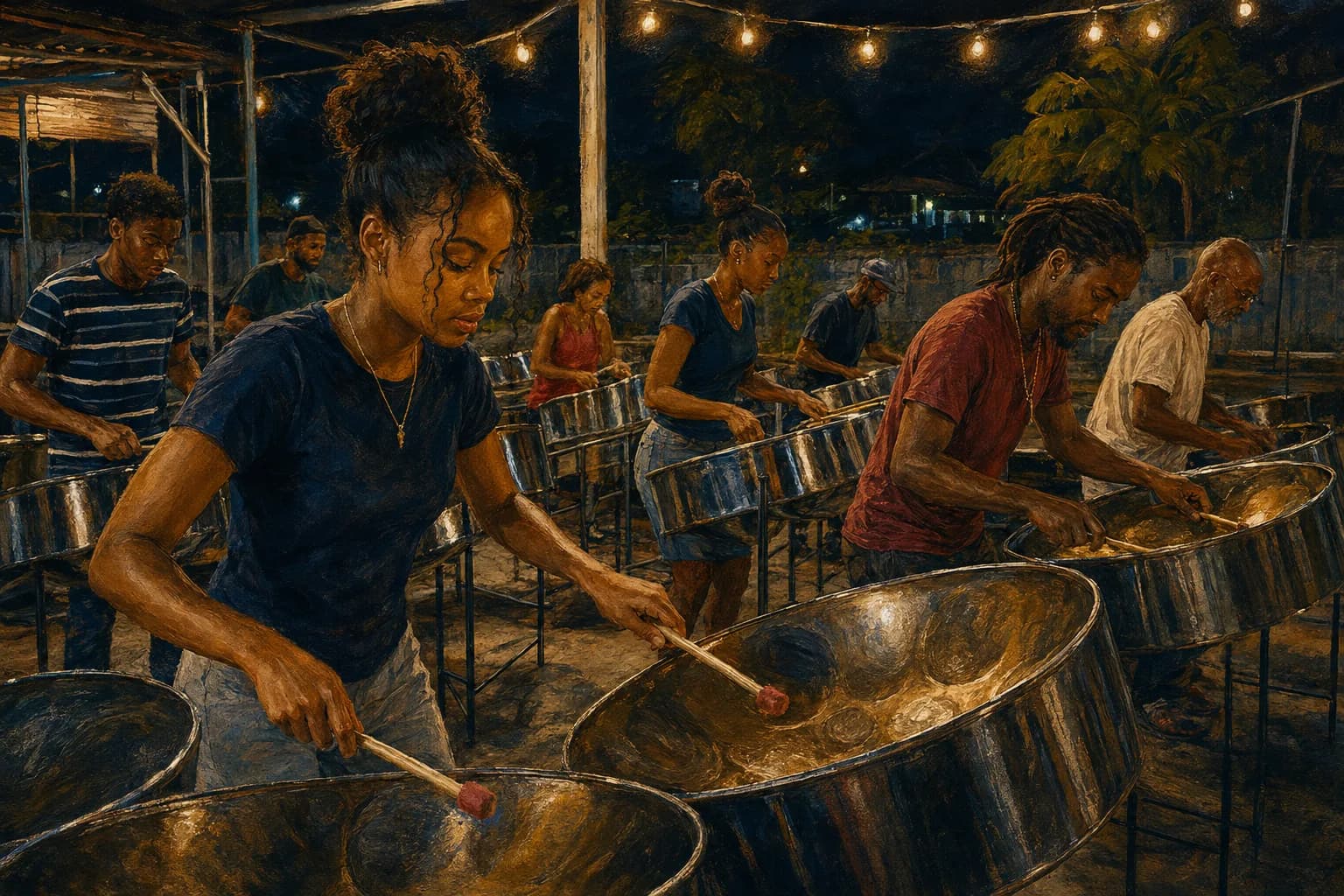
In the final weeks before Panorama, a familiar scene unfolds late at night in panyards across Trinidad: nobody is going home. Under strung-up floodlights, a hundred players stand at their instruments — tenors up front, double seconds and guitars behind, the six-bass at the back like a row of chrome oil tanks, because that is what they once were — and they are playing the same eight bars for the eleventh time. The arranger stops them again. He heard something: one player in the second-pan section, a fraction behind the run. He doesn't say who. He doesn't have to. "Again." Sticks up. The phrase comes back around — sixteen pans hitting a passage of sixteenth notes in perfect unison, a sound like silver machinery — and this time he lets it live, and moves to the next eight bars. It is a Tuesday. They will do this until two in the morning, and tomorrow, and every night until the Savannah.
Steelpan gets introduced to outsiders as a postcard — the sunny plink behind a resort cocktail. Inside the culture it is closer to the opposite: one of the most demanding disciplines in popular music, rehearsed with the intensity of an orchestra and the stakes of a title fight. The panyard is where that discipline lives, and the panyard is the story.
What a panyard actually is
A panyard is, at minimum, an open-air rehearsal space where a steelband keeps and plays its instruments. In practice it is a neighborhood institution doing five jobs at once. It is a music school where children learn an instrument for free that they could never afford to buy. It is a second home — kids do homework at panyard tables, get fed from panyard pots, get watched by panyard elders. It is an apprenticeship system, where a twelve-year-old starts by pushing racks and packing sticks and rises, over years, to a frontline tenor. It is the neighborhood's public square, its pride, and often its safest space. And for two months a year it is a competitive war room.
The names carry weight the way football clubs carry weight. Renegades, from Charlotte Street, the most decorated band in Panorama history. Desperadoes, of Laventille hill — the steelband as the flag of a community the country too often only otherwise names in crime reports. Trinidad All Stars, playing since the 1930s. Phase II Pan Groove, built around the arranger Len "Boogsie" Sharpe's genius. Exodus in the east, Fonclaire and Skiffle in the south. Each with generations of families inside it — grandmother played, mother played, child plays — and each pointed, every year, at the same target: Panorama, the national steelband championship held since 1963, where large bands of a hundred-plus players compete before judges and a Savannah crowd, and where the difference between first and third can be a single untidy run in the third variation. Bragging rights last exactly one year. Then the yard fills again.
The discipline, itemized
Here is what the postcard leaves out. A Panorama tune is roughly eight minutes of original arrangement — a calypso or soca reworked into something close to a symphonic movement, with introductions, key changes, counter-melodies, a "jam" section, variations — and every note of it is memorized. There is no sheet music on the racks. A hundred players hold eight minutes of intricate, fast, multi-part arrangement entirely in their bodies, learned phrase by phrase, by ear and repetition, over six to eight weeks of rehearsals that run four, five, six nights a week, deep into the night, on top of day jobs and school.
The arranger teaches it out of their head — section by section, "sectionals" where the basses drill alone while the tenors rest — and the discipline is enforced with affection and absolutely no mercy: again, again, again, until the phrase is not merely correct but together, a hundred wrists moving as one wrist. Behind the players stands the invisible staff the sound depends on: the tuners — craftsmen who sink, groove and blend each drum's notes by hammer and ear, an art form in itself — the section leaders, the people who cook, the drivers, the parents on the benches. When a big band crosses the Savannah stage and eight minutes of silver thunder comes off it looking effortless, you are watching several thousand collective hours made briefly invisible.
From oil drum to national instrument
The history makes the discipline mean more. Pan was invented in the poorest yards of Port of Spain — Laventille, John John, east Dry River — in the late 1930s and 1940s, by young Black Trinidadians who, in the long shadow of colonial bans on African drumming, coaxed melody out of what the society had discarded: biscuit tins, paint pans, and finally the 55-gallon oil drums the petroleum industry left lying about. Pioneers like Winston "Spree" Simon and Ellie Mannette worked out how to sink a drumhead and hammer true notes into it — one of the twentieth century's most consequential new acoustic instrument families — while respectable Trinidad called panmen hooligans and the police broke up their yards.
The instrument beat the stigma the hard way: excellence. TASPO, the all-star steel orchestra, stunned crowds at the Festival of Britain in 1951; the bands kept refining; the middle classes' children started sneaking into panyards; and in 1992 Trinidad and Tobago declared the steelpan its national instrument. The thing invented by the scorned became the sound of the nation — which is why the panyard's culture of rigor is not incidental. Discipline was the argument. It still is.
The yard, exported
Wherever Trinidadians settled, they built panyards, and the yards run on the same rules at colder latitudes. In Brooklyn, bands rehearse through August nights for the Labor Day Panorama, steel ringing off Flatbush blocks. London's bands drill for Notting Hill's competition; Toronto's for Carnival season on Lake Ontario. The details transpose — a rented lot, a warehouse, a school gym in winter — but walk into any of them in the crunch weeks and you will find the identical scene: floodlights, racks, a hundred memorized minds, an arranger saying "again," and neighborhood kids learning, along with the music, the panyard's true curriculum — show up, listen, hold your part, carry the racks, respect the elders, repeat until excellent.
The practice room is the real story. The shine of steelpan is public — the Savannah, the stage, the eight silver minutes. But the shine is only the receipt. The purchase happens at eleven o'clock on a Tuesday night, eleventh repetition, sticks up. Again.
Editorial note
LuxTuris original
This is evergreen editorial context from the LuxTuris desk, not live breaking news or invented social proof.