HeritageNine Night: How Jamaica Refuses to Let the Bereaved Mourn Alone
For nine nights after a death, the Jamaican yard becomes a public place of care — hymns and dominoes, grief and laughter, in the same room.
LuxTuris Editorial Desk · July 12, 2026
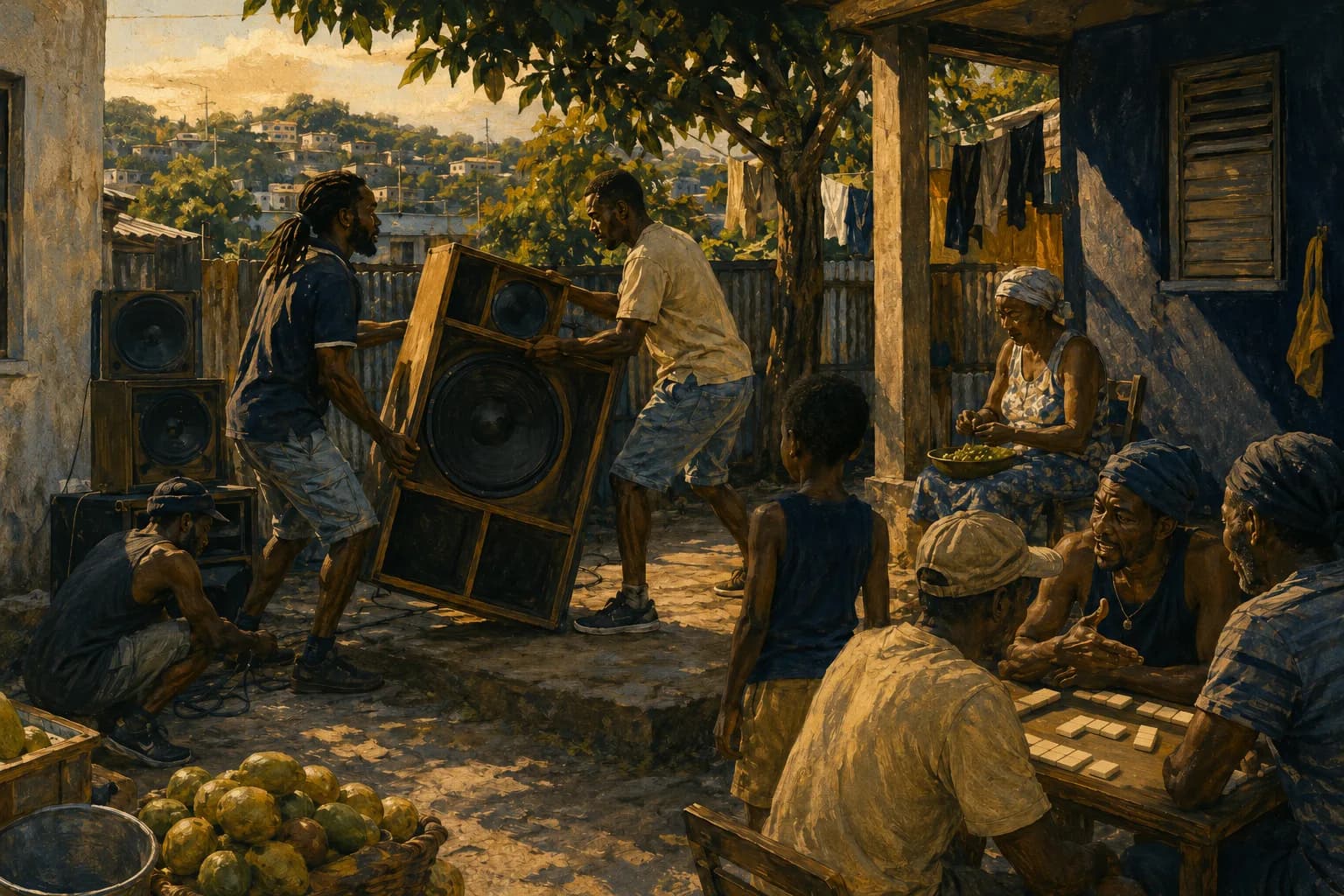
When someone dies, the yard begins to change. Chairs arrive from neighbours. A tarpaulin may be raised against rain or dew. A pot goes on. By evening, people are moving between the kitchen, the veranda and the domino table, carrying food, news, stories and the practical work that sorrow makes difficult.
In Jamaica, grief rarely belongs to one household.
Some come to sing. Some bring money. Some sit with the family until daybreak. Others arrive because absence would be noticed, and because they understand that mourning creates obligations among the living.
Across many Jamaican communities, the gathering reaches its fullest expression on the ninth night after death. The customs differ by family, district, denomination and spiritual tradition, but the principle is remarkably durable: the bereaved should not be abandoned to silence.
Nine Night is often described as a wake. That is accurate, but incomplete. A wake can suggest a single vigil around a body. Nine Night is better understood as a period of communal attendance, culminating in a night when memory, religion, food, humour and older ideas about the passage from life to death occupy the same yard.
The gathering does not erase grief. It gives grief company.
A house made public
Death temporarily changes the boundaries of a Jamaican home. The private house becomes a public place of care. Relatives travel. Neighbours lend chairs, prepare food, run errands and receive visitors. People who cannot afford a large contribution bring what they have, including their presence.
The atmosphere can unsettle outsiders expecting mourning to remain solemn. A Nine Night may hold hymns and laughter, prayer and dominoes, tears and teasing recollections of the dead within the same hour. None of this diminishes the loss. The movement between sorrow and ordinary life is part of how the community bears it.
Stories do essential work. The person who died is restored through remembered phrases, habits, arguments and acts of kindness. A formal tribute may polish a life. The yard returns its texture.
The ninth night may draw the largest gathering. In some families, doors or windows are left open. Furniture may be moved. Water, food or rum may be set aside. Such practices are sometimes understood as helping the spirit depart or marking the end of its immediate presence in the home. In other households, especially those shaped by conservative Christian teaching, the night centres on scripture, hymns and fellowship, with little or no reference to spirits.
There is no single authorized Nine Night. Its variations are not corruptions of the tradition. They are evidence of the different histories Jamaica has learned to carry at once.
The sound of the night
Music gives the gathering its emotional structure.
In many yards, an elder begins a hymn and others find the line behind them. The singing may draw from the Sankey hymn tradition associated with the nineteenth-century evangelist and hymn writer Ira D. Sankey, but Jamaican voices have long made those songs their own. Tempo, phrasing and repetition change in the yard. A hymn printed in a Victorian songbook becomes something heavier, more communal and unmistakably local.
In parts of eastern Jamaica, particularly where Kumina traditions remain strong, drumming, movement and spiritual practice may shape the observance differently. Kumina carries Central African cultural memory and has survived in Jamaica through generations of practitioners, especially in St. Thomas and neighbouring parishes. It should not be treated as a dramatic embellishment to a generic wake. It is a distinct religious and cultural tradition with its own knowledge, leadership and protocols.
That distinction matters. Nine Night sits near several streams of Jamaican life without belonging exclusively to one of them. African-derived understandings of ancestry and spirit, Christian worship, European wake traditions and local community practice have met and changed one another over generations. The result is neither a museum survival nor a simple mixture. It is a living Jamaican institution, revised each time a family must use it.
The architecture of care
The deepest purpose of Nine Night may be social rather than ceremonial.
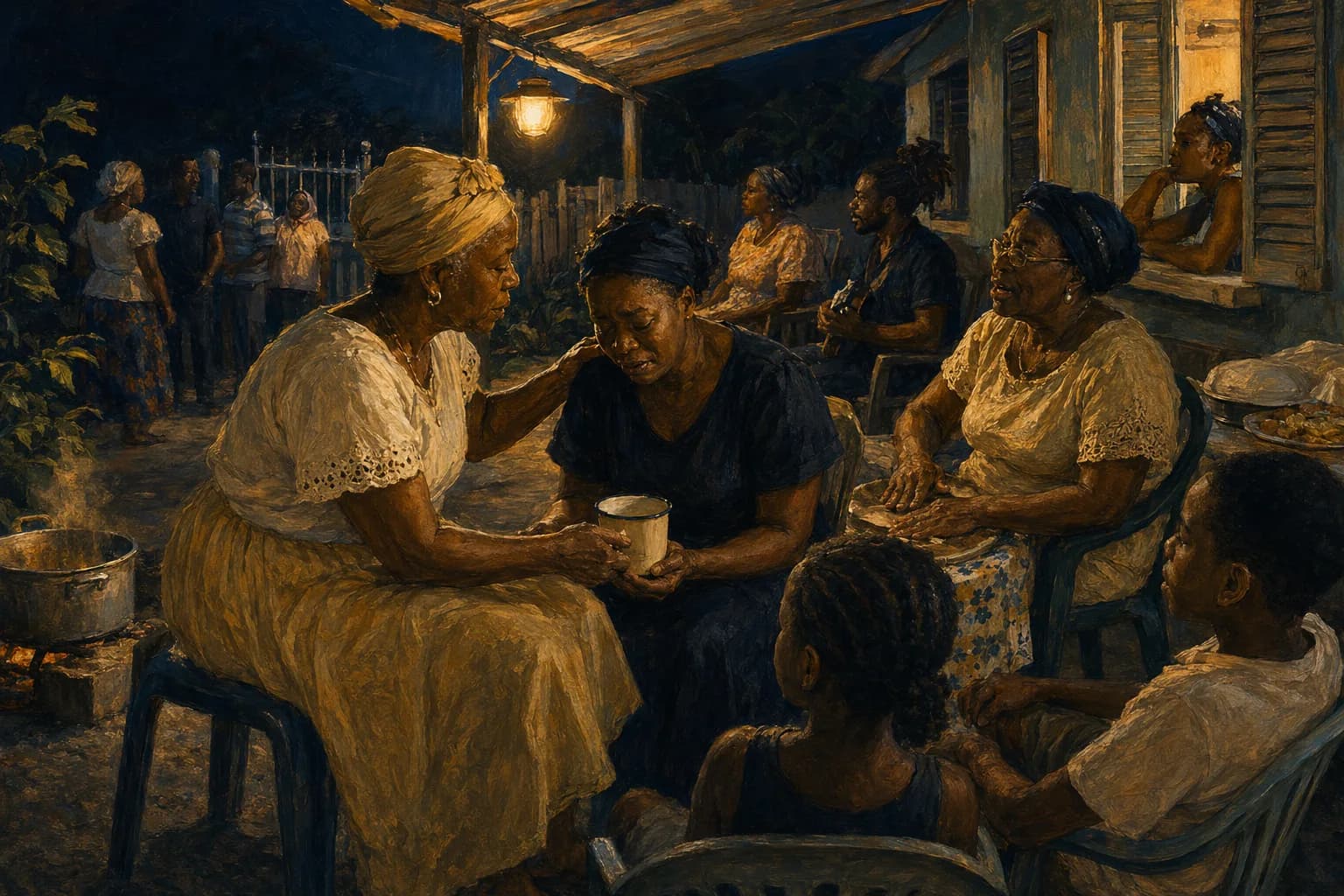
For days, the bereaved are fed, watched over and relieved of decisions. Someone knows who still needs to be called. Someone has found more ice. Someone is serving coffee before dawn. Someone is sitting beside the relative who has not yet been able to cry.
This is care without the language of care work.
The gathering also makes reciprocity visible. People attend because the deceased mattered, because the family matters, and because community is sustained through remembered acts of presence. The person serving soup tonight may need the same hands in their own yard years from now.
That obligation can be beautiful. It can also be expensive. Feeding visitors, renting tents and chairs, providing music and preparing for a funeral place real pressure on families. Not every household can, or wishes to, maintain gatherings across several nights. Some observe only the ninth night. Others combine the tradition with a memorial service or celebration of life. Migration, church practice, funeral costs and changing work schedules continue to reshape what is possible.
A tradition survives not by remaining untouched, but by continuing to answer a need.
What crossed the water
Nine Night travelled with Jamaicans to Britain, Canada, the United States and elsewhere. In diaspora cities, the yard may become a front room, church hall or community centre. The gathering may be compressed into one evening. Food may be catered. Relatives in Jamaica may join by video while hymns move between rooms and time zones.
The setting changes, but the central problem remains: how does a scattered family gather around a death?
Natasha Gordon's play Nine Night brought that question to the British stage in 2018 through a London Jamaican family negotiating grief, ritual and generational distance. Its power came from a tension familiar far beyond the theatre: descendants may inherit the responsibility for a tradition without inheriting complete instructions.
That uncertainty is not proof that the culture has failed to travel. It is part of diaspora life. Customs remembered by one sibling may be rejected by another. A younger relative may know the chorus but not the verses. Someone must call Jamaica to ask what happens next.
The call itself is continuity.
What the living keep
Nine Night is sometimes presented as folklore, a word that can make a living practice sound quaint, fixed or safely past. In the families that maintain it, the tradition is more practical than that. It organizes food, labour, memory, belief and companionship around the moment when a household is least able to organize itself.
Its achievement is not that everyone believes the same thing about death. They do not. Its achievement is that disagreement does not prevent attendance.
The devout and the doubtful may sit in the same yard. One person sings for the soul. Another sings for the family. Someone remembers a joke the deceased told badly, and laughter interrupts the hymn. The night makes room for all of it.
By morning, the chairs will need stacking. The pots will need washing. People will return to work, school and the ordinary demands that continue without permission.
The absence will remain.
But for one night, and often for several nights before it, the family did not have to meet that absence alone.
That is the quiet authority of Nine Night. It does not promise to defeat death. It gathers the living closely enough to survive its arrival.
Editorial note
LuxTuris original
This is evergreen editorial context from the LuxTuris desk, not live breaking news or invented social proof.