Hosay: Mourning, Memory, and Belonging in Trinidad
A Muharram observance shaped in Trinidad over generations, with a history that includes the 1884 colonial shootings outside San Fernando.
Kellan Vail · July 8, 2026
Updated September 23, 2026
On the road
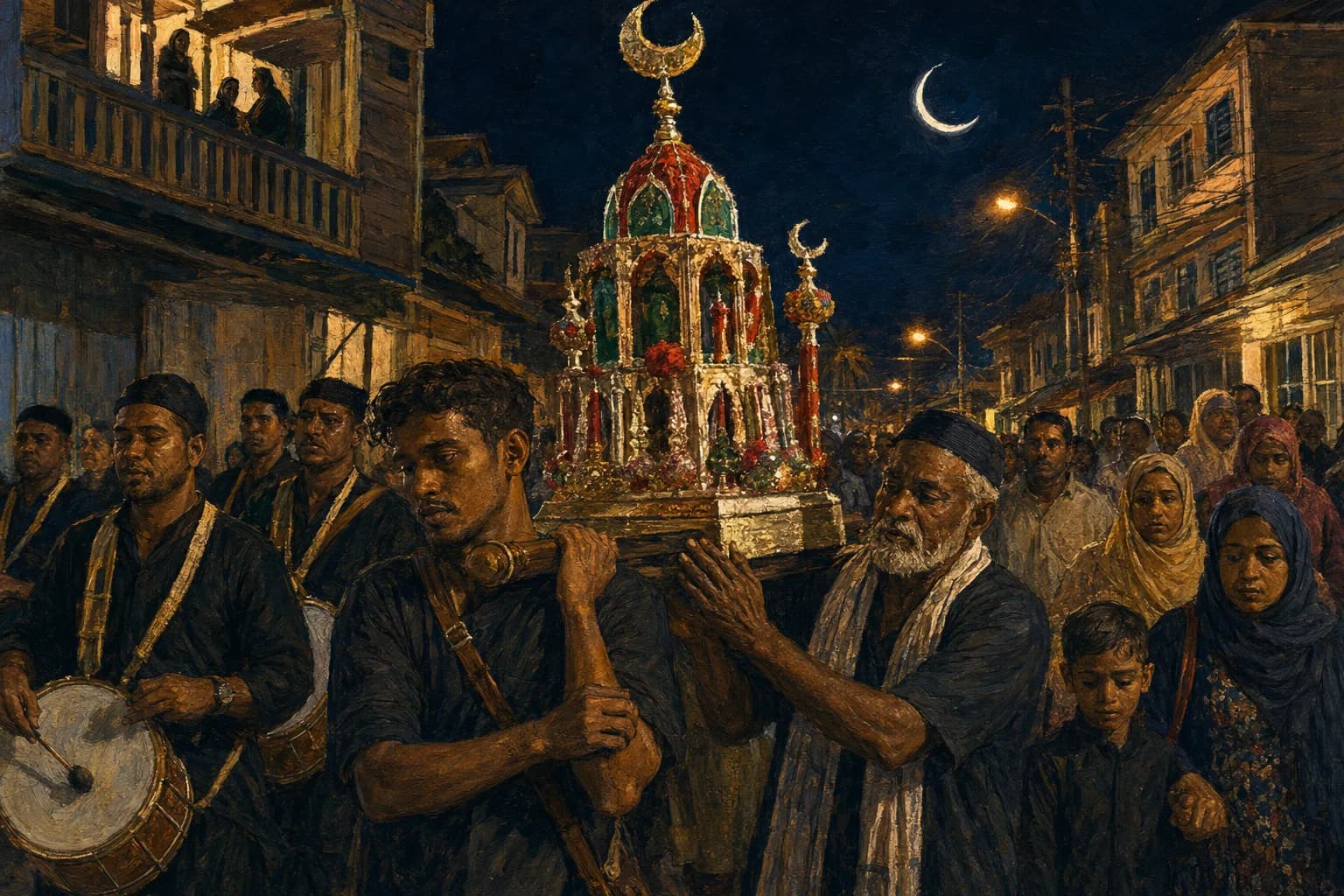
In St. James, Trinidad, Hosay takes shape in tadjahs, ceremonial structures built and decorated in neighborhood yards. Drummers and participants accompany them through the streets. The national library's photographs record the size and color of these processions, but the structures are more than a display: they belong to a mourning observance rooted in Muharram.
Hosay recalls the killing of Husayn, the Prophet Muhammad's grandson, and his companions at Karbala. Ashura, the tenth day of Muharram, is the central day of remembrance. The procession is one public expression of a religious history carried to Trinidad by Indian indentured workers. Its visual force should not obscure the prayers and preparation around it.
A Trinidadian observance
The National Library and Information System Authority records a Hosay observance in San Fernando in 1847 and evidence of celebrations in St. James and Chaguanas by 1865. Muslims and Hindus took part in the early Trinidadian observance. Participation later reached beyond those communities, giving the procession a place in the wider cultural life of the island without erasing its Shia origins.
St. James has five Hosay yards. The library names their processional order as Panchaiti, Cocorite, Gulam Hussein, Balma and Bis Ali. That order reflects the seniority of the yards. The work happens well before a tadjah reaches the road: members meet for prayer, prepare food, and build and decorate the structures that will be carried in procession.
The first six days are given to gatherings and preparation rather than street processions. Flag Night comes on the seventh. The eighth brings the small tadjahs and the moons, or alams, into the streets. On the ninth night, the large tadjahs emerge. Each stage has its own place in the observance; the large procession is neither its beginning nor its whole meaning.
On the tenth day, Ashura, the yards join a daytime procession through St. James. The tadjahs and moons return to their yards before evening. The sea immersion comes later. After a day without public activity, the twelfth day, Teejah, brings final prayers, a community meal, the dismantling of the tadjahs and their immersion.
The violence of 1884
Hosay also belongs to Trinidad's history of colonial control and resistance. An 1884 ordinance prohibited processions from public roads. On 30 October of that year, colonial police fired on Hosay participants approaching San Fernando, killing people and wounding many more. This event is remembered as the Muharram or Hosay Massacre.
The precise death toll is disputed. Historian Bridget Brereton writes that at least 16 people were killed; a later account in Trinidad and Tobago's Senate gives 22. Neither figure should be presented as an undisputed final count. A University of the West Indies study describes the confrontation as part of a struggle over Indian cultural self-expression under colonial rule.
The massacre should be remembered without collapsing the whole observance into a memorial to 1884. Hosay's central religious story concerns Karbala. Its Trinidadian history also includes the people who sustained the yards, the processions, and the right to carry them in public. Both histories deserve their own space.
What remains
The recurring work of construction matters. A tadjah can be built with great care and then dismantled; the knowledge involved has to be carried by people willing to make it again. St. James's processional order, the prayers, the flags, the moons, and the final immersion are all parts of that continuity.
For a visitor, the most respectful starting point is to recognize the observance as mourning before admiring its color. For those who keep it, the work reaches across generations. Each year the yards prepare again, and the road holds a practice that colonial prohibition did not end.
Sources and further reading
- NALIS: Hosay in Trinidad and the St. James observance
- NALIS: St. James history and the 1884 ordinance
- Bridget Brereton, University of the West Indies: violence and the 1884 massacre
- Trinidad and Tobago Parliament: Senate debate, 23 March 2010
- University of the West Indies: Hosea Riots of 1884 thesis abstract
See an error? Send a correction.