
The Words We Know but Cannot Always Say
For some Jamaicans raised abroad, the language of home lives vividly in the ear and hesitantly on the tongue. That space is worth understanding, not judging.
Kellan Vail · October 15, 2026
Updated October 15, 2026
Your ear knows before your mouth does.
You can follow the direction of a family conversation, recognize the sharp turn of a joke, understand when a familiar expression means more than its literal words. Then the attention turns toward you, and the answer arrives in English. Not because you have forgotten where you come from. Maybe because you never learned to build the sentence as quickly as you learned to understand it.
For some people with Jamaican roots who grew up abroad, this is the peculiar geography of a heritage language: intimate enough to feel like home, unfamiliar enough to make speaking it feel like stepping onto a stage.
The uncomfortable part is how easily people turn language into a test of belonging. If you cannot answer in Jamaican, are you somehow less Jamaican? If you can repeat the phrases but do not know when to use them, have you really learned anything? The questions sound simple until they are directed at someone trying to connect with a part of their family.
There is another way to look at that distance. Instead of asking people to perform a version of home on command, we could ask what it takes to listen well enough to preserve it.
The language never needed an apology
Jamaican is not English that has gone wrong. Jamaican Creole has its own grammar, vocabulary and patterns of use, with variation across speakers and settings. People may move between Jamaican and Standard Jamaican English according to context, audience and personal history. Calling one version of speech 'proper' can disguise the social judgments attached to each.
The University of the West Indies Jamaican Language Unit has been doing the serious work of treating Jamaican as a language that can be studied, described and taught. Its bilingual education project, conducted from 2004 to 2008, examined how Jamaican and English could function in primary education. Research on classroom grammar teaching, including a UWI paper published in January 2026, continues to engage with what happens when language variety and education meet.
Those projects do not tell us exactly how a young adult in Toronto or Brooklyn feels when a relative asks a question. They establish something more fundamental: there is structure to learn, not merely an accent to imitate.
The Language Unit's workshops also introduce the Cassidy-JLU writing system, developed to represent Jamaican sounds consistently. An introductory UWI course on the language addresses grammar, usage, vocabulary and writing. That matters because the written version of a familiar phrase is not always obvious to someone raised mainly with English spelling. A learner deserves more than a spelling invented for a caption.
The fact that institutions take Jamaican seriously should change the way we approach it at home.
Listening is a form of knowledge
There is a difference between recognizing a sentence and being ready to produce it. You may understand what a speaker intends because you know the family, the situation, the rhythm of the exchange. Speaking asks you to choose words and forms before the moment passes.
That gap is not limited to Caribbean households, and it does not automatically tell us how fluent someone will become. But it explains why listening for years may not produce the same ease as years of conversation. It also helps explain why a mocking correction can make a hesitant speaker more hesitant. Language is social. So is the fear of making a mistake in front of people whose approval matters.
Not every family wants to become a classroom. Some relatives welcome questions; others may be tired of being asked to translate the ordinary details of their lives. Their knowledge belongs to them. The invitation to learn should include the freedom to decline.
When a willing speaker does agree, however, the smallest conversation can reveal more than a large collection of internet phrases.
The family archive that fits on one page
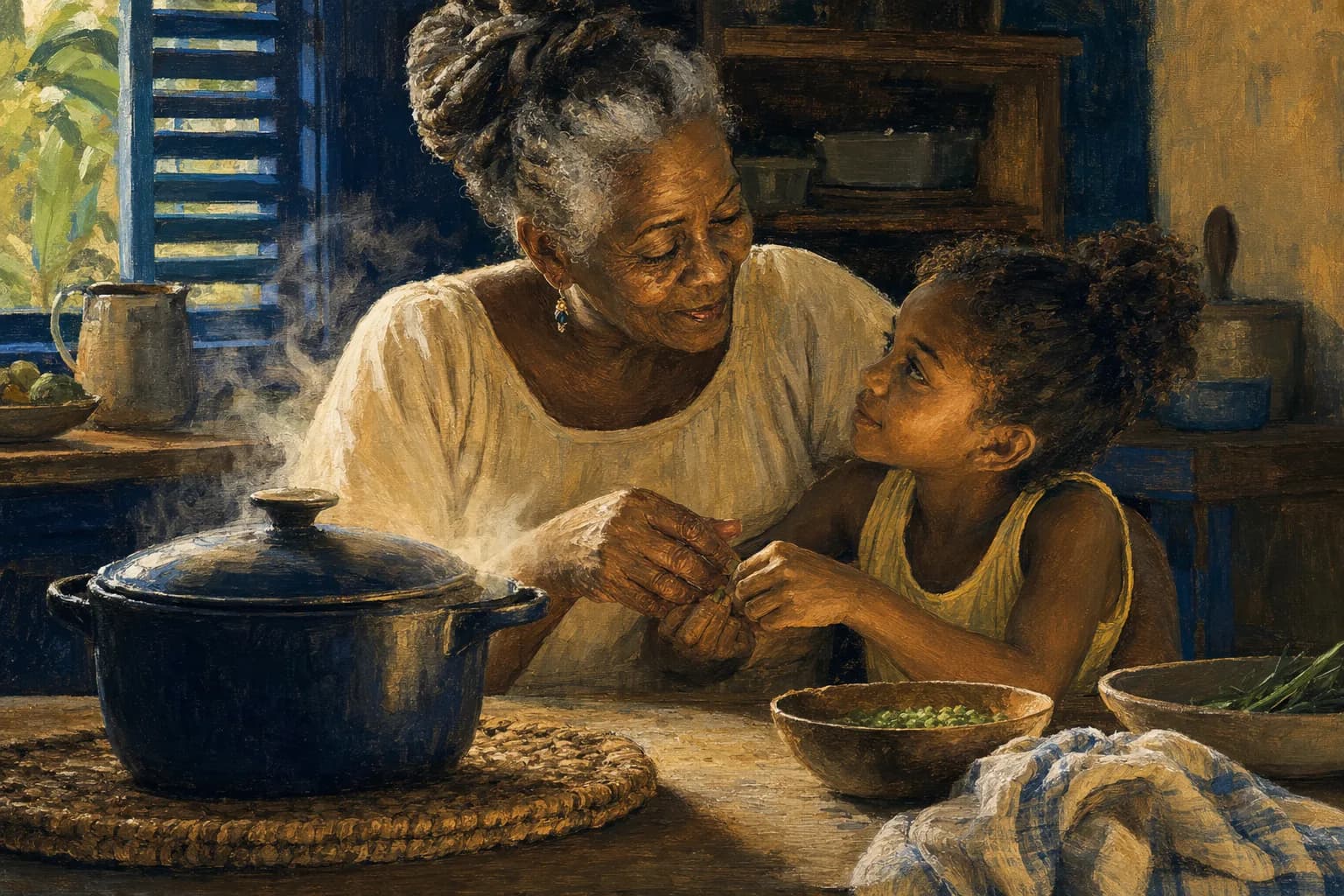
Imagine beginning with one household expression. You ask a relative what it means, when they would use it and where they remember hearing it. You write down what you think you heard. They correct you. Perhaps another relative uses a different form. Instead of deciding which one must represent an entire island, you preserve both, with the speaker's permission.
That is already a useful cultural document.
A simple family language notebook can hold five things: the speaker's chosen name or private identifier; the date and situation; the words as the speaker confirms them; the meaning and tone in that context; and any difference another consenting speaker remembers. You do not need to manufacture a perfect example, and you do not need to share the notebook publicly.
If the speaker agrees to an audio recording, explain who may keep it and whether any transcription service will process it. Do not upload a private voice simply because software can produce a transcript. A recording preserves a voice, but it does not transfer ownership of that person's story.
You can then try a short response in Jamaican, if the speaker wants to help you practise. Ask whether the phrasing sounds natural to them. When spelling is involved, return to the university's Jamaican writing resources rather than turning the relative's voice into a phonetic joke for social media.
This is not a substitute for a course, nor a scientifically tested route to fluency. It is a way to turn an ordinary act of listening into something more attentive: a record with a source, context and the possibility of correction.
More importantly, it changes who gets to decide what counts. The relative is not an exhibit. The learner is not a failed exam. Both are people in a conversation.
What survives the silence
For the diaspora, language can become an odd kind of inheritance. You may know when a sentence is affectionate, impatient or funny without being able to make another one yourself. You may keep the sound of a relative's voice long after the details have become difficult to explain to someone younger.
There is no single way to be Jamaican abroad, and speaking Jamaican is not the price of admission to a family history. But learning it, documenting it and respecting those who carry it are ways of refusing to treat that history as background noise.
The next time your ear knows before your mouth does, you do not have to prove anything with a perfect answer.
You could begin by listening closely enough to ask a better question. And perhaps that is how more of the language stays with us.
Sources and further reading
See an error? Send a correction.