LuxTuris
Premium photorealistic Grenada carnival editorial scene with dramatic warm light and cultural texture
Carnival
CarnivalGrenada5 min read

Before Sunrise: Jab Jab, Memory, and Grenada's Spicemas

Blackened in oil, horned, chained, laughing at the crowd — Grenada's J'ouvert devil mas is one of the oldest pieces of political theatre in the hemisphere.

LuxTuris Editorial Desk · May 14, 2026

jab jabgrenadaspicemascarnival

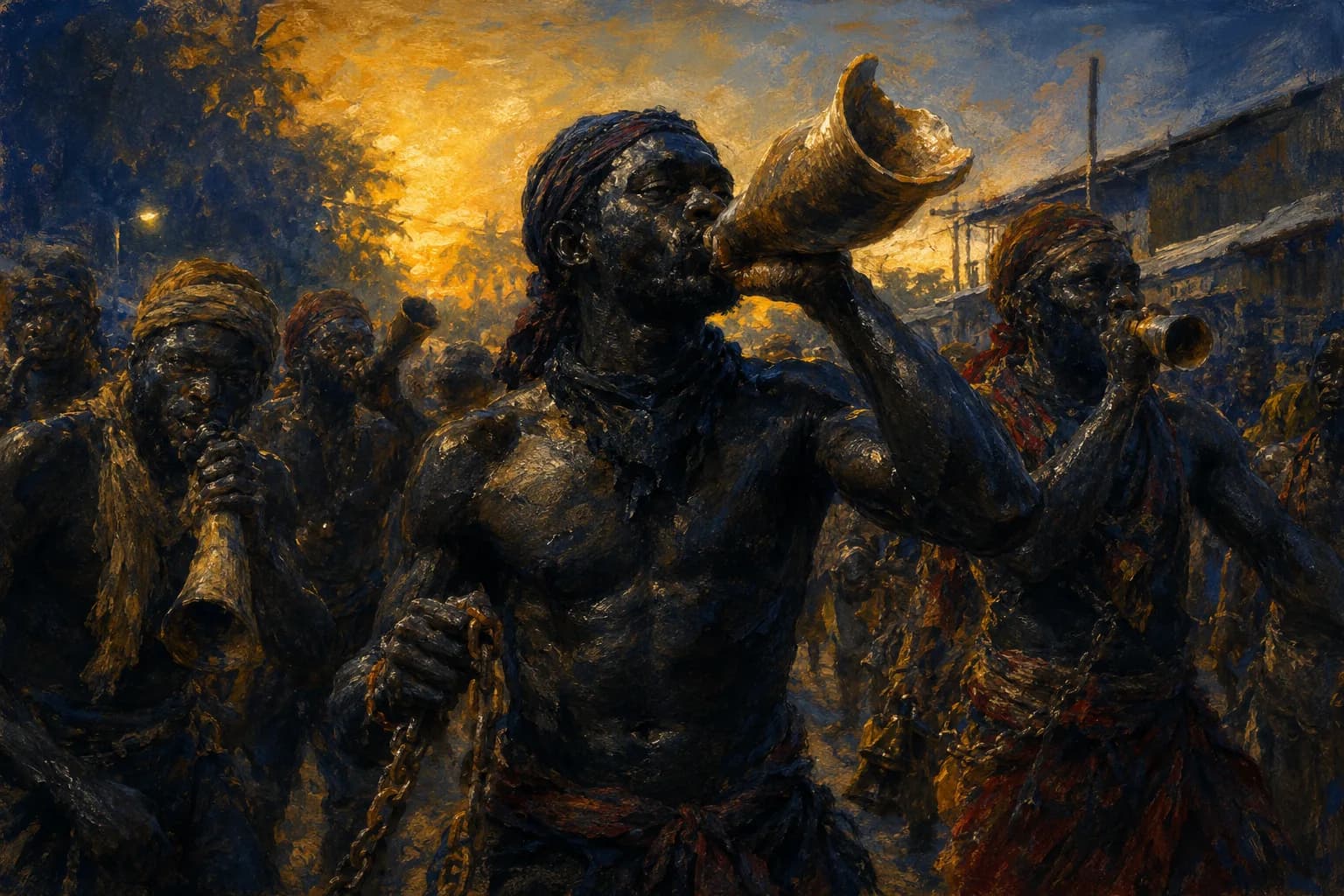
Before sunrise during Spicemas, Jab Jab announces itself through sound: conch shells, metal percussion, chains and call-and-response moving through the dark. Conch shells sound from somewhere up the hill. Chains drag on asphalt. Biscuit tins, brake drums and iron percussion approach the Carenage through the dark. Then the smell arrives before the bodies do: oil and other blackening materials. Masqueraders appear blackened from head to foot, wearing horns or carrying chains and other elements that vary by band, community and performer. A man stops in front of you, grins, and holds his oiled palms an inch from your white shirt. The crowd around him laughs. He moves on. J'ouvert has begun.

If you arrive at this scene with no context, it reads as spectacle — and spectacle is the shallowest possible reading of Jab Jab. What is moving through the streets of Grenada on J'ouvert morning is not a horror costume. It is one of the oldest pieces of political theatre in the hemisphere, performed annually, in oil, by the descendants of the people who invented it.

The devil the master invented

The name comes from Grenadian French Creole: jab from diable, devil. Say it twice and you have the mas. The history is layered — Grenadians themselves will hand you more than one origin story — but every version runs through the plantation. You called us devils, black and dangerous and less than human? Fine. Here is your devil — blackened darker than you ever imagined, horned, chained, and laughing at you.

The early jabs covered themselves in molasses and later stale molasses mixed with soot — the literal by-product of the sugar economy that had consumed their ancestors' lives — before the tradition shifted to tar, grease, and eventually the old engine oil used today. What persists is the masquerade's power to claim the road and confront spectators with histories that polite Carnival imagery can conceal.

That is why Jab Jab is often called the soul of Spice Mas, Grenada's August carnival. The pretty mas comes later, in the daylight — feathers, beads, sequins, the road march. J'ouvert belongs to the jab. And Grenadians will tell you, with some pride and some edge, that while other islands have devil mas traditions, nowhere holds it the way Grenada holds it. In Grenada, jab is not one option in the costume catalogue. It is closer to a birthright.

How you learn to play jab

Nobody downloads this tradition. It moves the way the most durable Caribbean culture always moves — through households and villages, older cousin to younger, one J'ouvert at a time.

A Grenadian child sees the oil pan in the yard before they are old enough to play. They watch an uncle mix the oil, watch the older boys practice the walk, learn which conch shell call belongs to which village band. In places like Grenville and the villages of St. Andrew's and St. Patrick's — parishes with fierce jab reputations — the pre-dawn assembly is a community event with its own quiet protocols: who mixes, who leads, who carries the chains, what the chants are and what they answer. The first time a young person oils up and joins the band is a genuine rite of passage, and the elders around them are not just supervising a party. They are handing something over.

That handover comes with instruction, spoken and unspoken. You learn that the jab's menace is performance — the oiled palms held an inch from the tourist's shirt, never pressed to it without invitation. You learn that the chains and horns carry the weight of specific history, and that the point of looking like a devil is to remind everyone watching who did the actual devilry. You learn that J'ouvert is joy and mourning occupying the same body, which is something carnival does better than almost any other human institution.

The camera problem

Here is the tension the tradition now lives with, and it deserves honest reporting rather than hand-wringing.

Jab Jab is spectacularly photogenic. Oil-black bodies against dawn light, horns silhouetted, the sheer visual force of a thousand jabs on the move — it is some of the most striking imagery the carnival world produces, and in the last decade it has traveled far beyond Grenada. That reach has brought real benefits: visibility, visitors, a wave of soca built on jab rhythms and jab pride that has given Grenadian artists a signature sound. When a Grenadian abroad sees jab imagery cross their feed, it lands as recognition.

But the same reach flattens. An image stripped of context becomes an aesthetic — a "look" to be borrowed for a music video or a themed fete on another continent, devils with no history attached. Visitors arrive wanting the photograph without wanting the meaning, treating masqueraders as props in someone else's content. And Grenadians notice. There is an ongoing, sometimes sharp conversation on the island about protecting jab from costume-ification: elders and mas practitioners insisting that you cannot separate the oil from what the oil means, that a tradition born from mocking the powerful should not be reduced to decoration for the entertained.

The instinct to guard it is not gatekeeping for its own sake. It is archival. Jab Jab is one of the Caribbean's living primary sources — a document of resistance that happens to be performed rather than written — and the people who maintain it understand that a document copied carelessly enough times eventually loses its text.

Playing jab, knowing

So what does it mean to play jab — or to stand on the roadside at J'ouvert and watch — knowing the history?

For the Grenadian in the band, it means the oil is inheritance. It means moving through the same streets where freed people once claimed their first free mornings, carrying the same satire they invented, adding one more year to an unbroken record. Ask a jab why they play and the answers are rarely academic; they say it is freedom, they say it is in the blood, they say you cannot understand until the oil is on you. All of which is another way of saying the mas still works — it still does the thing it was built to do.

For the visitor, it means arriving as a witness rather than a consumer. Learn before you go. Ask before you photograph a person, not just a crowd. Wear clothes you are willing to lose, because oil or paint should never override consent. Ask practitioners about local expectations, keep respectful distance when needed and do not treat contact as an entitlement. And understand that the fearsome thing rolling toward you in the half-light is not pretending to be a devil. It is telling you, in the oldest voice Grenada has, how Grenadians have turned frightening imagery into memory, satire, possession of the road and collective power.

The sun comes up over the Carenage. The oil starts to shine. The chains keep time. The memory holds.

Editorial note

LuxTuris original

This is evergreen editorial context from the LuxTuris desk, not live breaking news or invented social proof.

The Pulse: the Caribbean, in your inbox.

A free letter from the LuxTuris desk. New essays, island stories, and the best of the Journal.

Keep reading

Related stories