The Dish That Crossed Oceans: Ackee, Saltfish, and Jamaica
Jamaica's national dish joins ackee and salted cod, with a safety rule that matters far more than any recipe argument.
Kellan Vail · July 11, 2026
Updated September 23, 2026
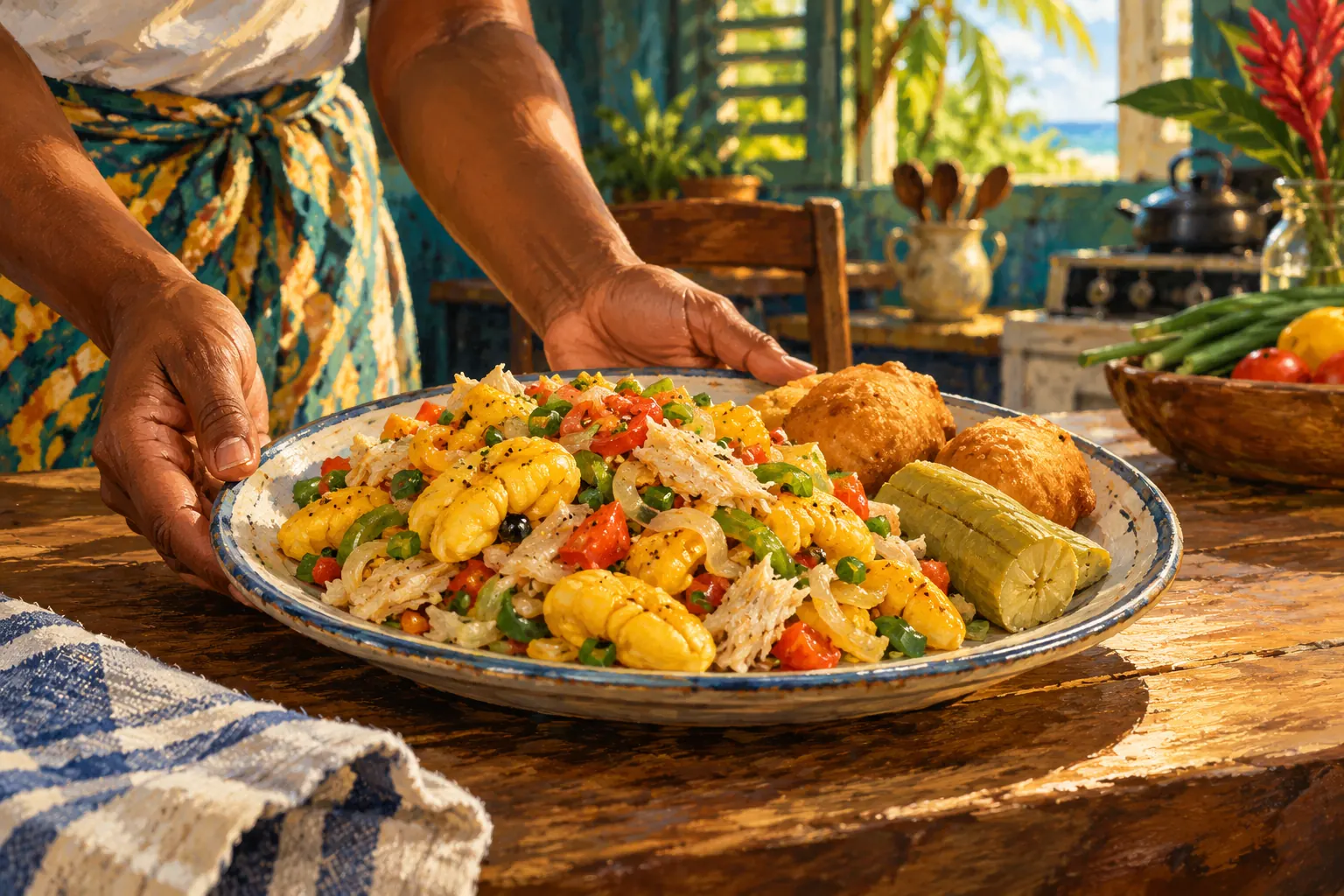
Ackee and saltfish is Jamaica's national dish, but no single kitchen owns its final form. It may arrive with fried dumpling, green banana, plantain or other provisions. The Jamaica Tourist Board describes ackee cooked with salted cod and seasonings as a familiar breakfast. The combination seems settled on the plate even as its ingredients tell different histories.
The tree and the fish
Ackee, Blighia sapida, is native to West Africa. Jamaica's National Library identifies it as the national fruit and describes its arrival in the eighteenth century, while acknowledging uncertainty about the route. A familiar story assigns its introduction to Captain Bligh; the available summaries do not establish that he brought the first ackee tree to Jamaica. It is more responsible to distinguish the plant's African origin from the later European name.
Salted cod crossed the Atlantic as a durable traded food. The pairing of an African fruit with fish preserved for a transatlantic market became a Jamaican dish through local practice. Its history belongs to those who cultivated, prepared and ate it, not merely to the ships that moved ingredients. A precise first cook or first serving cannot be recovered from these sources.
The rule before the recipe
Ackee also carries a real food safety risk. The US Food and Drug Administration warns that unripe fruit contains high levels of hypoglycin A, and that even ripe fruit has high levels in the seeds and rind. Heat does not make unripe ackee safe. The fruit must ripen naturally, and the edible arils must be handled and processed correctly.
That is not an invitation to experiment with a closed pod. The FDA tells consumers not to prepare raw ackee without training and describes controls used for imported canned and frozen products. A tin is useful to cooks far from the tree, but processing controls, not the can itself, are what make it trustworthy. Readers should use the FDA's current guidance and product information rather than a scene in a food story as a preparation manual.
A dish carried forward
With safely processed ackee, cooks still have choices. The salt of the fish, the softness of the fruit and the balance of onion, tomato, pepper or herbs vary among preparations. There is a difference between describing that range and inventing a grandmother whose hand stops a stirring spoon. The dish does not need a fictional kitchen to have personality.
Its enduring appeal can be seen in what it allows: a food from West Africa prepared with a traded fish became unmistakably Jamaican. People at home and abroad can make and share it in more than one way. The safety belongs in the story as plainly as the pleasure.
Sources and further reading
See an error? Send a correction.